I’m no authority in what places are the must-dos. But I can tell you which are the ones I went to. I’ll sprinkle in some basic information along the way and tell you about my experience. Your trip will be different than mine. But I thought I’d share what I saw.
Before I began my trip to Latin America, I spoke to a Brazilian who grew up in Sao Paulo. He told me to skip his hometown altogether. I get his rationale.
Sao Paulo is a big city. And many of its characteristics are shared with other mega hubs in the world. Depending on the perspective, that can be a draw or a turnoff.
Sao Paulo is the New York of South America. And I see the city more as Manila. Both have more than 20 million residents. And the city is congested with people, opportunities, and dreams.
I also visited in Rio de Janeiro and Manaus. You can see the places I visited in Rio de Janeiro in this link. You can read my story in the Amazon in this link.
Meanwhile, here are five places I visited in Sao Paulo:
Parque Ibirapuera
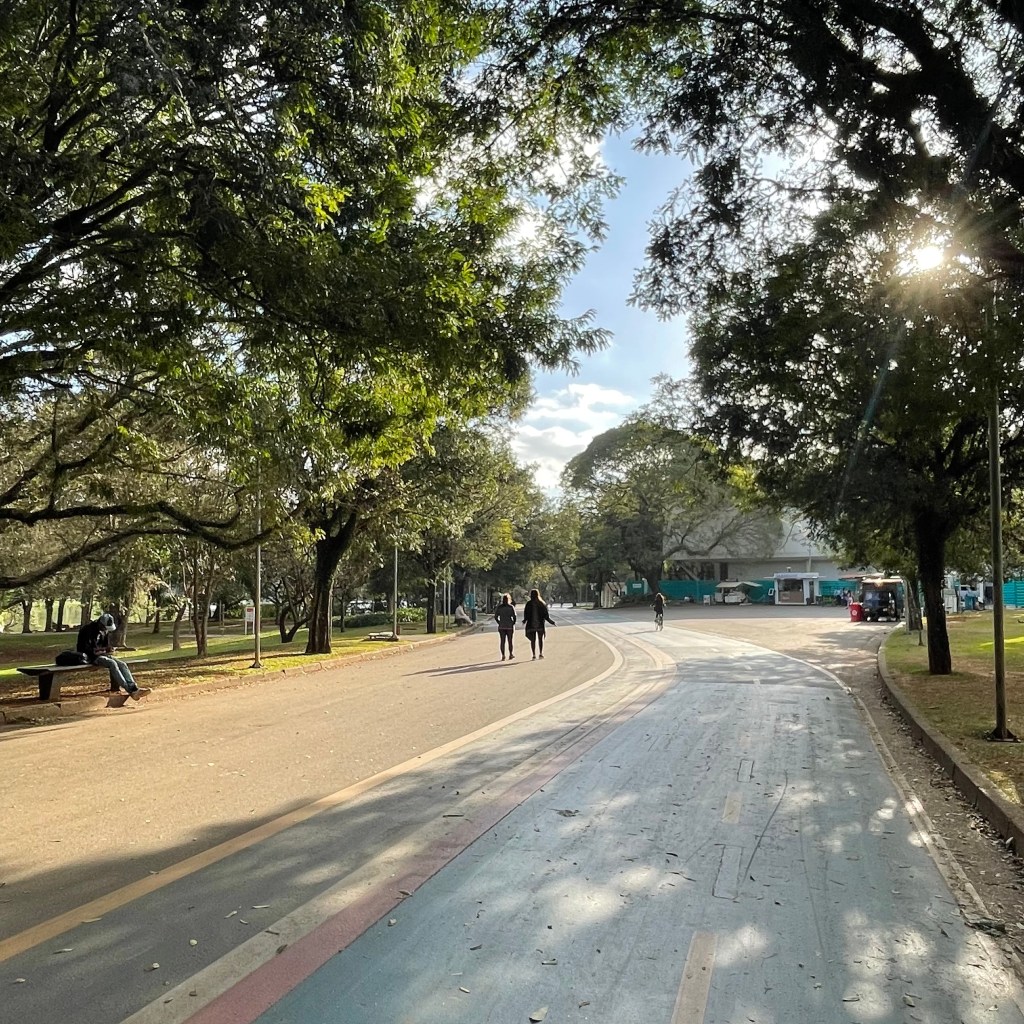
Parque Ibirapuera is a green oasis situated at the centre of a hustling and bustling city. Over 1,500 acres of land and the park is filled with different offerings for people from all walks of life – whether sightseeing, relaxation, recreation, arts or festivals.
Besides getting my cardio steps in, I visited two museums in the park. It was a Thursday. And apparently, in Brazil, each museum has a day per week where tickets are free. I got lucky as both were free on Thursdays. That is something any visitor may want to keep in mind.
The first one was the Sao Paulo Museum of Modern Art. For my personal taste, the exhibition was a bit too abstract (colour and light) and/or too short (feminism). So I enjoyed my time in the other place a bit more.
The second one I visited was the Museum of Afro Brasil. Having lived in Europe for two years, the perspective of the colonised is something I rarely encounter. The Afro Brazilians have been marginalised and their voices are finally starting to be heard. The exhibition was fresh, provocative, and engaging.
There’s also a planetarium within the complex. This is apparently the most popular attraction within the compound. Given the time I had, and my limited interest in science, I skipped it.
The Museum of Art of Sao Paulo Assis Chateaubriand (MASP)
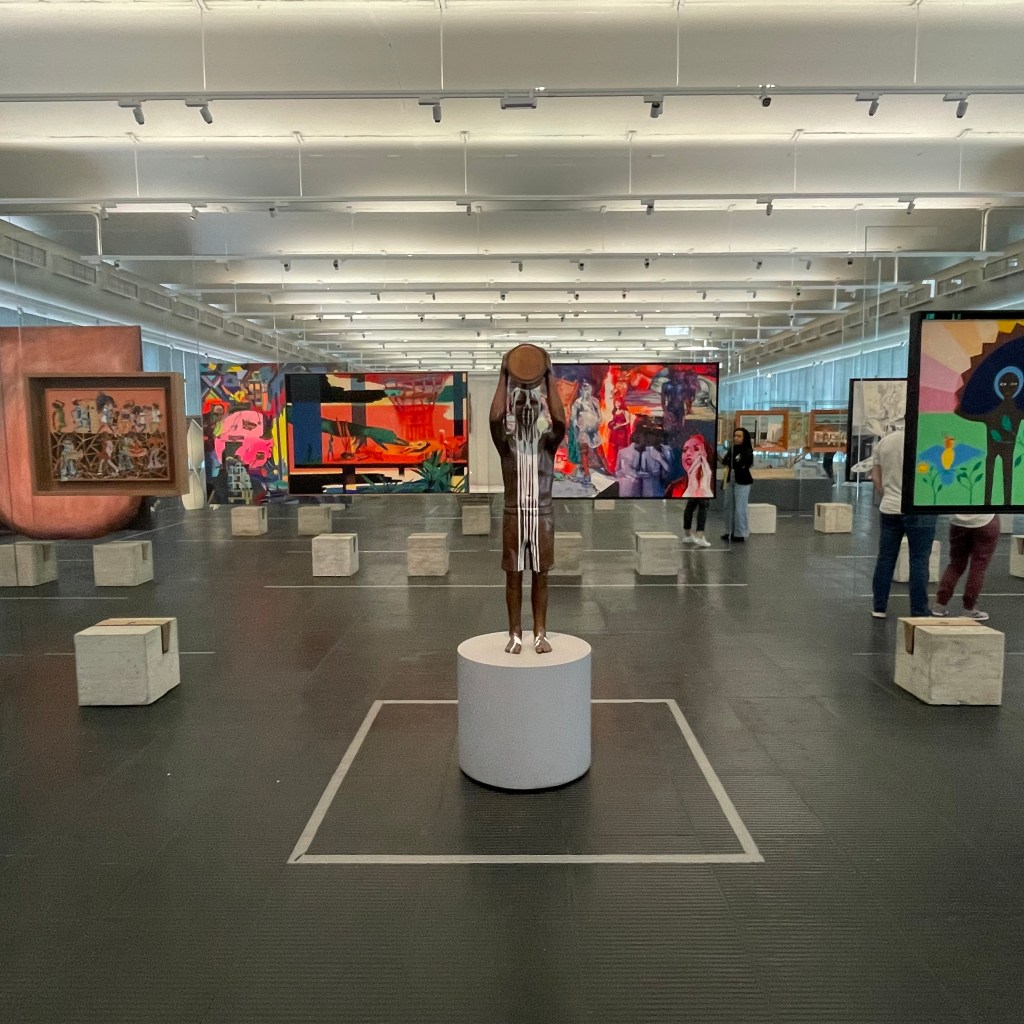
I’m not an art enthusiast. But I enjoyed my time here and I thoroughly examined the exhibitions.
In the permanent collection, the way the artworks is displayed is unique. The pieces aren’t stuck to a wall. Rather, they are in clear acrylic easels positioned on an open space. All descriptors are found at the back. This forces the visitor to digest what’s in front of their eyes without any text immediately giving away the intended meaning or backstory.
There are Western pieces from the likes of Van Gogh and Monet. That has lost a bit of its charm for me. I didn’t go to South America for European works.
The museum has art made by women and non-white communities. And those caught my eyes more. I often wonder whether the prestige society puts on works of art is a function of who colonized a given society.
The museum is not afraid to criticise itself. A piece of art commented on how significantly more women are featured nude as a percentage of nude art THAN there are actual works of art made by women in relation to all the pieces.
I thought that was bold and demonstrated self-awareness. But of course, something more than a commentary must be done to rectify the situation.
The Mercado Municipal de Sao Paulo
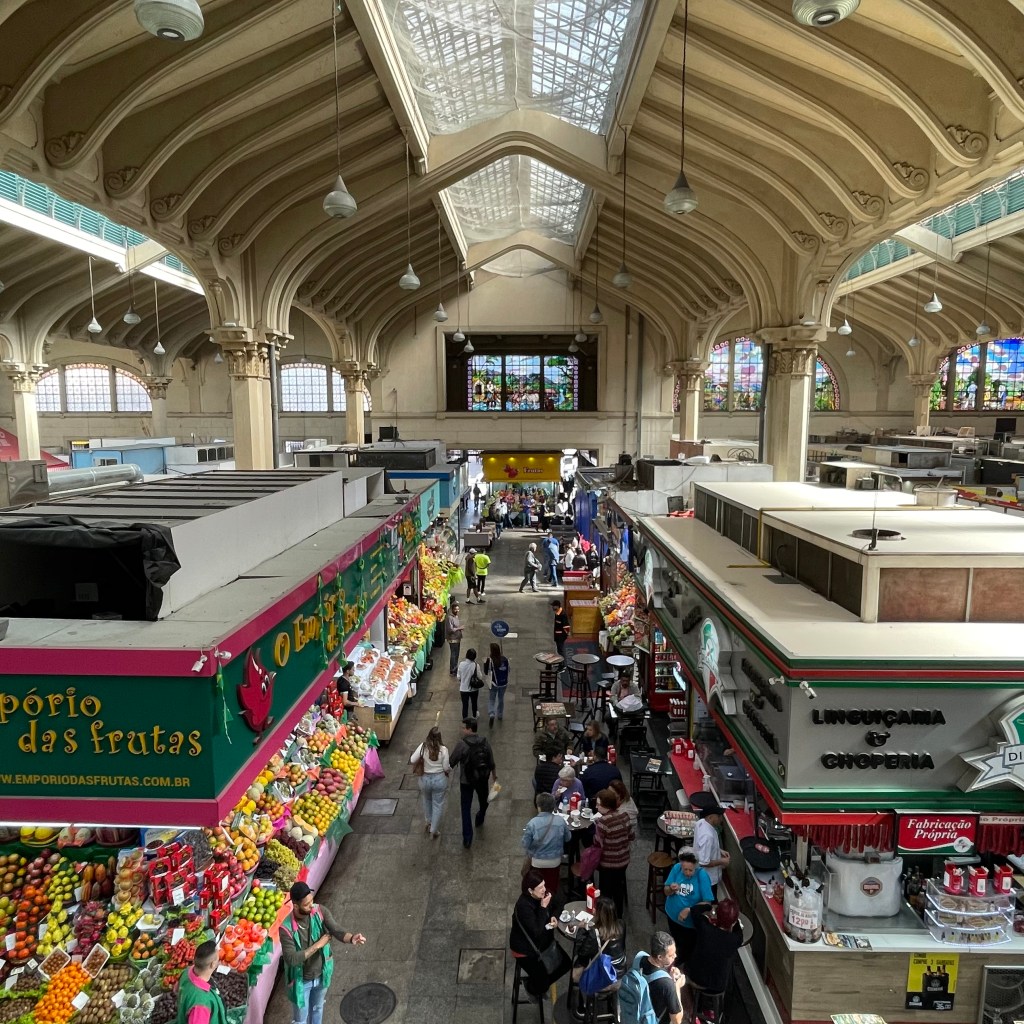
Largely due to the traffic and the language barrier I encountered, getting access to a variety of local food wasn’t easy. But for a one stop shop, the easy solution is the Mercadao.
The marketplace is vibrant and filled with diverse food – fresh produce, staple ingredients, and Brazilian snacks and meals. So for a curious and adventurous taste pallet like mine, this worked perfectly. And the vendors know this. They are used to it and are happy to engage tourists.
Here, I had my Camarao com Catupiry (Shrimp Pastel with Brazilian Cheese). I would give the dish a chef’s kiss.
But this place is known for other food such as Acai (popular nutritious Amazonian food), Mortadella (Italian sausage) and Coxinha among others.
Food is an obvious draw. But for architecture geeks, the design is described as exquisite.
There is a dome and an elaborate stained glass seen from the outside. And the building is adorned with paintings and expensive tilework on the inside. Without looking at the cuisines on display, the building can be mistaken as European.
Batman’s Alley (Beco do Batman)
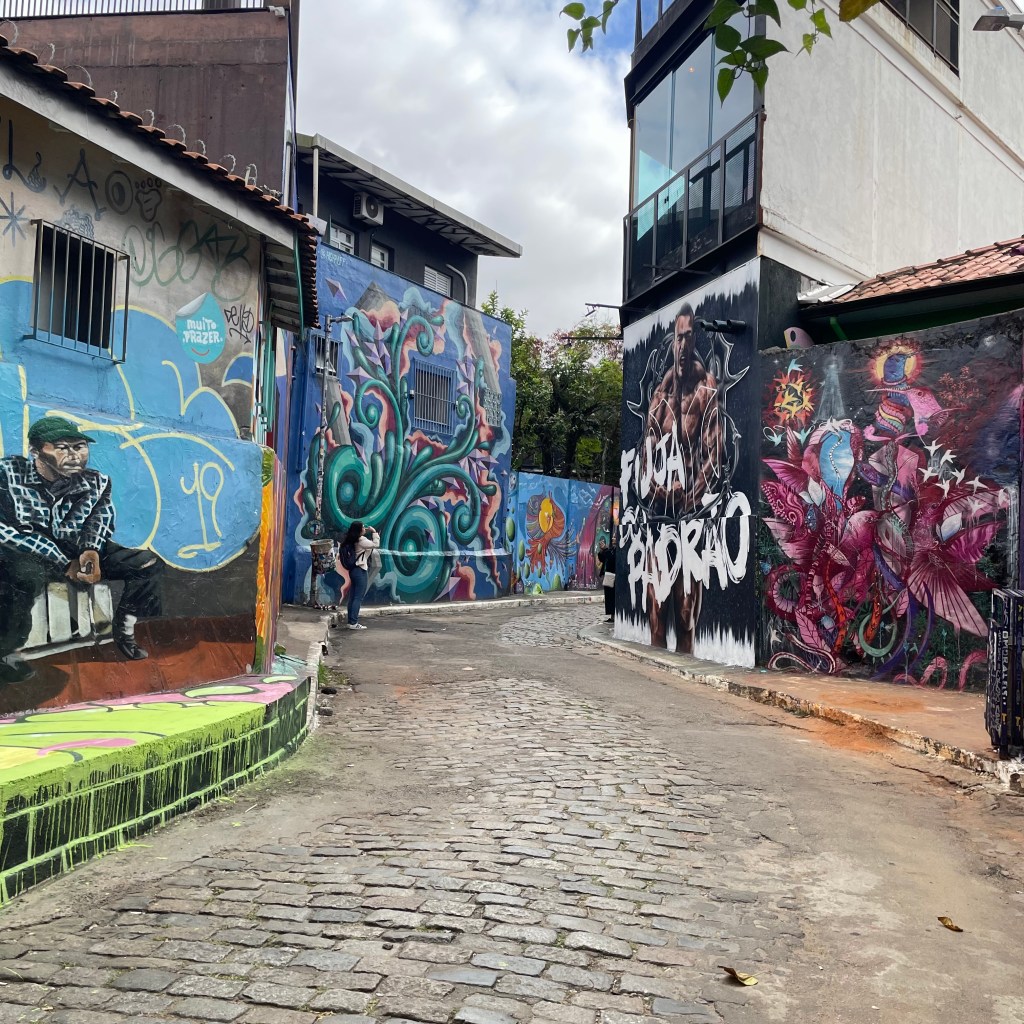
The street is located in the bohemian neighbourhood of Vila Maladena. And this is Sao Paulo’s entry in the list of Instagrammable spots. The grafitti walls are like an open air gallery.
While named after Batman, the works of art featured go beyond superheroes. The name referred to a mural of Bruce Wayne. The title was catchy and it stuck. Nowadays, everyone refers to the place as Beco do Batman or Batman’s Alley.
Graffiti is everywhere and constantly changing. So a repeat is not out of the question.
Tourists taking photos never end. I am one of them.
There are cafes and bars to chill in. There are shops and galleries to visit. And overall, it’s a great showcase to Sao Paulo’s art and culture.
The Pinacoteca de Sao Paulo
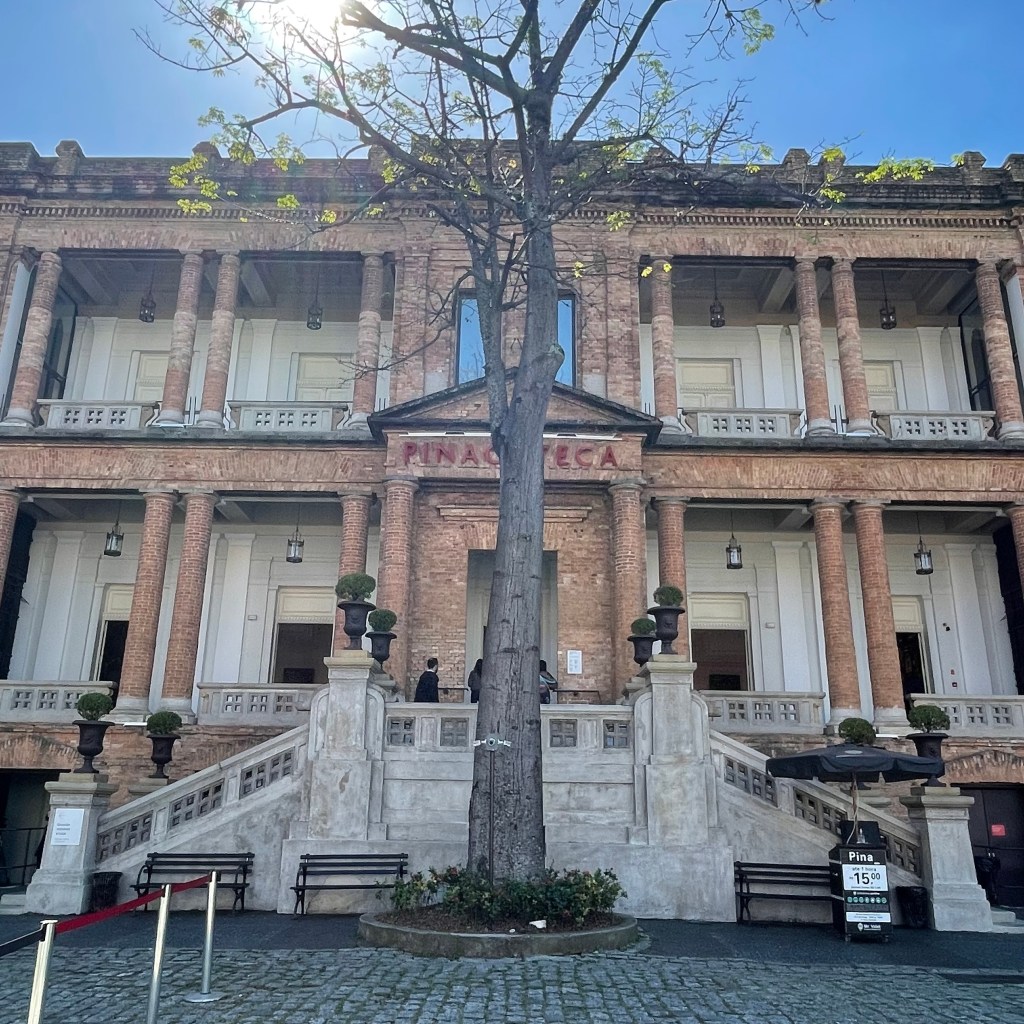
I almost didn’t visit this museum. But I’m glad I did.
While I’m not able to grasp and appreciate everything on display, I believe it’s important for each country to showcase their national artists. This offering provides diversity in the dominant art narratives and is a step forward in breaking down hierarchies often perpetrated by colonisers.
Pedro Americo, Victor Meirelles, Almedia Junior, Anita Malfatti, and Candido Portinari. Consider me ignorant. But these are names I’ve never heard of. And I appreciate seeing their work and getting educated.
The trip to Sao Paulo happened in May 2023.


